
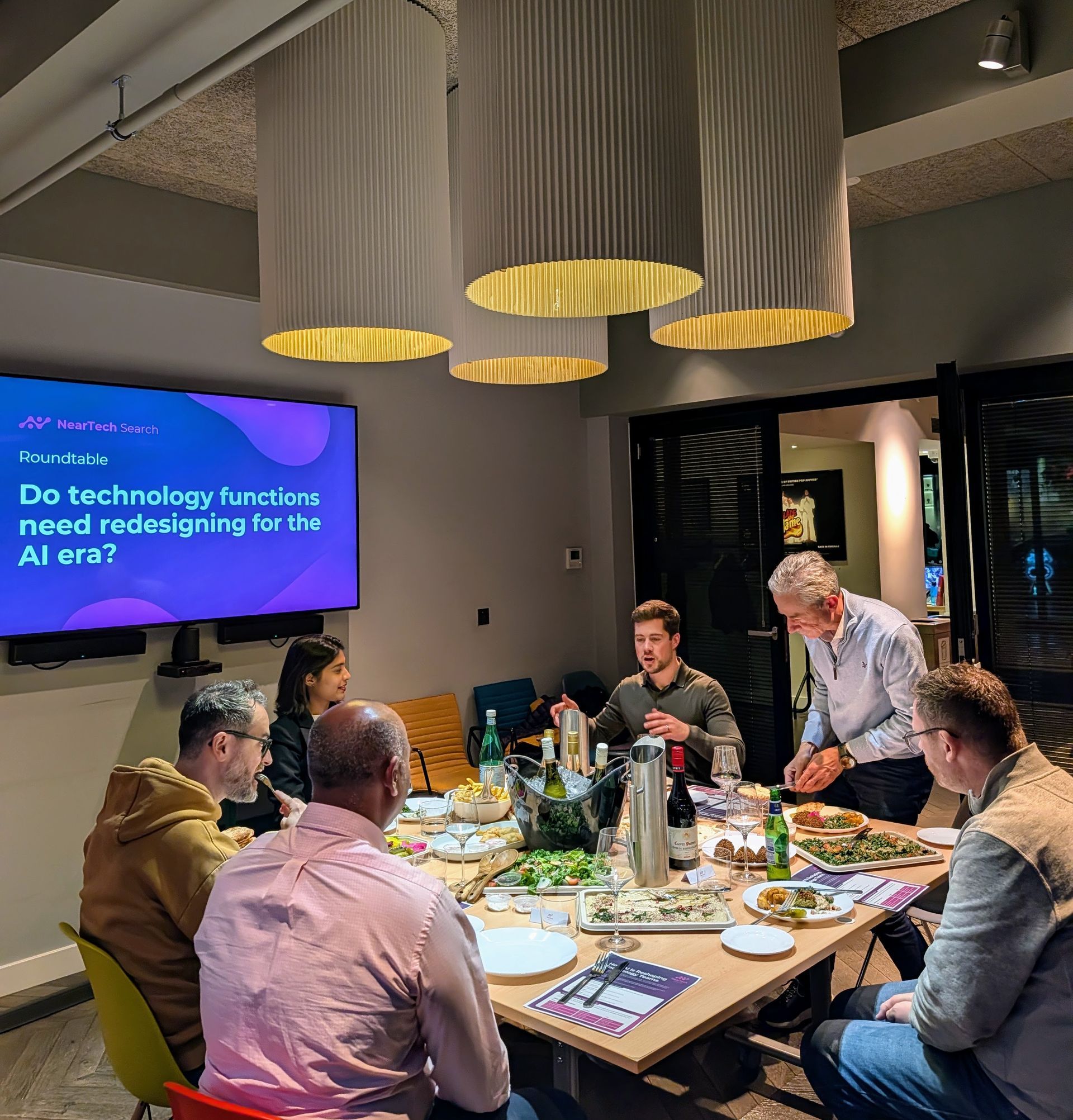
Nine takeaways from our CTO roundtable on whether technology functions need redesigning for AI, from hiring for curiosity to the junior engineer question.

As AI continues to reshape the technology landscape, the pressure on engineering and technology leaders is increasing rapidly. Teams are being asked to move faster, deliver more with fewer resources, modernise platforms, integrate AI responsibly and rethink what high performance looks like in a technology organisation. These themes sat at the centre of NearTech Search’s recent Manchester CTO roundtable, where technology leaders came together to discuss the realities of scaling modern tech teams, platform engineering, AI adoption and the changing expectations placed on leadership teams. What became immediately clear throughout the discussion was that the conversation around scaling has fundamentally changed. The focus is no longer purely on hiring growth. Instead, organisations are thinking more carefully about operational efficiency, AI enablement, engineering effectiveness and how to build adaptable teams capable of navigating continuous technological change. Below are the key themes and insights that were touched on during the event. Scaling Is No Longer Defined by Headcount Growth One of the strongest themes from the evening was that many businesses are actively trying to slow hiring growth rather than accelerate it. For years, scaling technology teams often meant increasing engineering headcount as quickly as possible. However, the discussion highlighted how priorities are changing. Technology leaders are now far more focused on improving output, reducing delivery friction and building smaller teams that can operate more effectively. Several attendees discussed how investor expectations and commercial pressures have pushed businesses to think differently about growth. Rather than simply asking how quickly teams can hire, organisations are increasingly focused on how they can achieve more with the teams already in place. One of the most repeated ideas throughout the discussion was the importance of scaling operationally rather than structurally. Leaders spoke about using AI tooling to remove repetitive workloads, improving platform capabilities and enabling engineers to work across broader parts of the stack more independently. A particularly striking comment from the discussion captured this perfectly: “How do we deliver more with the same team?” This mindset is now influencing everything from hiring strategy to platform investment and engineering team design. Key Takeaway: High-growth technology businesses are increasingly prioritising productivity, operational efficiency and smarter tooling over rapid headcount expansion. AI Is Changing What Strong Technical Talent Looks Like Another major area of discussion centred around AI and how it is already reshaping engineering teams. The conversation moved well beyond whether AI will impact technology roles. The consensus in the room was that the impact is already happening. Interestingly, the discussion was not centred around replacing engineers. Instead, attendees focused on how AI is changing the shape of technical capability and what businesses now value most in engineering teams. Several leaders discussed how specialist roles are becoming broader, with adaptability and full-stack capability becoming increasingly valuable. The ability to learn quickly, apply judgement and understand wider business context was repeatedly highlighted as more important than narrow technical expertise alone. One CTO explained that their organisation is increasingly hiring for attitude over aptitude. The reasoning behind this was simple, technical skills can be taught. Curiosity and adaptability cannot. Several attendees also discussed how AI tooling is helping developers deliver faster, prototype more independently and reduce repetitive development tasks. However, there was strong agreement that the best engineers are still those who understand business context, apply sound judgement, solve problems effectively and recognise when AI-generated outputs are incorrect. One of the clearest conclusions from the evening was that AI amplifies strong engineers far more than it replaces them. Key Takeaway: Businesses are increasingly prioritising adaptable, commercially aware engineers who can work effectively alongside AI rather than relying purely on narrow technical specialisation. The Bigger Challenge Is Cultural, Not Technical One of the most interesting discussions throughout the evening focused less on the technology itself and more on the human response to it. Several CTOs spoke openly about the emotional and cultural challenges surrounding AI adoption within engineering teams. Attendees discussed engineers feeling uncertain about how their roles may change, concerned that years of specialist expertise could become less valuable, or hesitant about integrating AI into their workflows. This was particularly noticeable amongst highly experienced professionals who had spent years mastering specific technologies or disciplines. One attendee summarised the sentiment clearly: “Some people feel like this technology is devaluing the years they invested into their craft.” The businesses seeing the strongest progress were not necessarily those with the most advanced tooling. Instead, they were the organisations creating environments where experimentation felt safe, learning was encouraged, and conversations around AI remained transparent. There was strong agreement that organisations cannot simply mandate AI adoption. Leaders must actively support teams through the process and create cultures where continuous learning becomes part of day-to-day operations. Key Takeaway: Successful AI adoption is becoming as much a leadership and culture challenge as it is a technology challenge. Platform Teams Are Becoming Strategic Enablers Platform engineering and DevOps functions were another major focus throughout the discussion. What became clear is that platform teams are no longer viewed purely as infrastructure support functions. Instead, they are increasingly becoming strategic enablers across the wider engineering organisation. Technology leaders discussed how platform teams are helping businesses scale more effectively by improving developer experience, building reusable tooling, introducing governance guardrails, and enabling teams to move faster without compromising quality or security. One CTO described platform engineering as: “A force multiplier for the organisation.” Conversations throughout the evening touched on internal AI tooling, automated testing, governance layers, secure AI gateways, and AI-assisted migrations. Importantly, the focus was not purely on cost reduction. Instead, businesses are concentrating on how platform functions can remove operational friction and create more efficient delivery environments across multiple teams. Key Takeaway: Platform and DevOps teams are increasingly becoming central to enabling scalability, developer productivity, and faster delivery across engineering organisations. Expectations on Technology Leaders Have Increased Significantly Another clear takeaway from the roundtable was that the expectations placed on CTOs and technology leaders have expanded dramatically. Today’s technology leaders are not only expected to oversee engineering delivery. They are also responsible for understanding emerging AI tooling, driving experimentation, educating the wider business, assessing commercial impact, and balancing governance with innovation. One attendee captured this by saying: “The CTO role feels reinvigorated again.” There was a strong feeling throughout the room that technology leadership has moved back to the centre of business strategy. However, with that comes increasing pressure. Leaders are now expected to answer difficult questions around AI strategy, automation priorities, delivery speed, and long-term organisational direction. Several attendees also referenced growing levels of “change fatigue” across organisations as teams attempt to keep pace with the speed of technological advancement. Key Takeaway: Technology leaders are increasingly expected to combine technical expertise with commercial thinking, organisational leadership, and AI strategy. The Businesses Moving Fastest Are Creating Cultures of Experimentation One of the final themes throughout the evening was that the businesses progressing fastest are not necessarily those with the biggest budgets or largest engineering teams. Instead, they are the organisations creating environments where experimentation is encouraged, learning is shared openly, and teams feel empowered to test and adapt quickly. Attendees discussed internal AI workshops, shared prompting sessions, developer-led learning initiatives, and cross-functional experimentation as examples of what this looks like in practice. In contrast, businesses struggling most with adoption were often those where AI usage remained hidden, governance lacked clarity, or teams feared making mistakes. One of the clearest takeaways from the discussion was that AI adoption is becoming just as much a culture challenge as it is a technology challenge. Key Takeaway: The organisations adopting AI most successfully are creating cultures that encourage experimentation, continuous learning, and transparent collaboration. Final Thoughts The Manchester CTO roundtable highlighted just how quickly expectations on technology teams are changing. Scaling modern engineering organisations is no longer purely about hiring growth. It is about building adaptable teams, improving operational efficiency, enabling experimentation, and helping engineers work more effectively through stronger platforms and smarter tooling. At the same time, technology leaders are balancing increasing commercial pressure, organisational uncertainty, governance requirements, and the rapid pace of AI adoption. What became clear throughout the evening is that the organisations progressing fastest are not necessarily the ones with the largest teams or biggest budgets. They are the businesses creating cultures that support learning, experimentation, adaptability, and continuous improvement. At NearTech Search, we continue to work closely with technology businesses navigating these challenges, helping them build high-performing teams across engineering, platform, DevOps, AI, and technology leadership functions. Looking to scale your technology team or strengthen your platform and AI capability? Get in touch with us to explore how we can support your growth journey.

Artificial Intelligence (AI) and Machine Learning (ML) are no longer future-facing investments or isolated innovation projects. They have become core to how modern technology businesses build products, make decisions, and scale efficiently. As organisations move from experimentation into full operational integration, the question is no longer whether to adopt AI, but how quickly they can embed it into their core teams. This change has placed AI and ML talent at the centre of hiring strategies, with demand accelerating as companies compete to turn data into insight, automation into efficiency, and intelligence into a measurable competitive advantage. For high-growth tech businesses, the ability to attract and retain this talent is no longer a differentiator. It is a requirement for staying competitive in an increasingly data-driven market. This blog explores why AI/ML talent is now at the core of high-growth tech teams, and what this means for companies looking to scale effectively in 2026 and beyond. From Experimentation to Operational Dependence The role of AI within organisations has changed dramatically. What was once confined to pilot projects or innovation labs is now embedded into core business functions, from product development and customer experience to finance and operations. According to EY , AI is no longer about isolated use cases. It is about integrating shared intelligence across organisations, where human capability and machine capability work together to improve performance. In a similar vein, Qlik highlights that AI is no longer sitting in a pilot phase. It is already shaping how businesses operate at scale. This creates a very clear hiring need. Businesses now require AI/ML professionals who can build, deploy, optimise, and maintain systems in live environments. Without that capability in-house, many AI initiatives remain stuck at the proof-of-concept stage, never delivering the commercial impact leaders expect. For high-growth companies, this makes AI/ML talent a business-critical function rather than an experimental one. Powering Hyper-Personalisation and Product Differentiation In crowded markets, differentiation increasingly comes down to how effectively a company can use data. AI and ML allow businesses to deliver more personalised user experiences, smarter recommendations, predictive services, and products that improve continuously over time. As explored in this Medium article on AI tools and customer data analytics , AI-driven analytics are changing the way organisations understand customer behaviour. Businesses can now anticipate customer needs, identify patterns more quickly, and create more relevant and bespoke user journeys. This is especially valuable in sectors such as SaaS, fintech, and digital platforms, where customer expectations continue to rise, and differentiation is closely tied to user experience. Similarly, Business Weekly notes that startups embedding AI from day one can gain a significant strategic edge by building smarter, more responsive products that scale alongside user demand. This is not simply about efficiency. It is about creating products that feel more useful, more intelligent, and more adaptable than competing solutions. To do this effectively, businesses need AI/ML professionals who can move beyond theory and create practical, commercial applications. These professionals sit at the intersection of product, engineering, data, and business strategy, making them central to how modern tech teams innovate and compete. Closing the Talent, Data and Integration Gap One of the biggest barriers to successful AI adoption is not access to tools. It is the gap between data availability, technical infrastructure, and the talent needed to connect them. Many organisations already hold huge volumes of valuable data, but without the right expertise they struggle to structure it, govern it, and apply it effectively. According to Motherson Technology , competitive advantage is increasingly driven by proprietary data and the ability to continuously train and refine models against it. That means value does not come from AI alone. It comes from the combination of data, systems, and talent. Qlik also reinforces the importance of trusted, contextual data in making AI work effectively. In practice, this means businesses need people who understand not just models, but the wider ecosystem around them, including data quality, pipelines, infrastructure, governance, and business context. This is why AI/ML talent is becoming so important. High-growth companies do not just need technical specialists who can train models. They need professionals who can bridge the gap between raw data, integrated systems, and real business application. That broader capability is what turns AI from a promising idea into an operational advantage. Enabling Faster and Smarter Decision-Making AI is also reshaping how organisations make decisions. In high-growth environments, speed matters, but speed without accuracy can create costly mistakes, leading to poor perception and lack of credibility on an already saturated market. AI and ML help teams move faster by processing large datasets, identifying trends, forecasting outcomes, and surfacing recommendations in real time. As highlighted by RocketSource , AI can support faster and better-informed business decisions by revealing patterns and opportunities before they affect performance. MS Dynamics World similarly points to AI’s growing influence in finance and operational planning, where the technology is being used to improve efficiency, accuracy, and strategic insight. This shift toward decision intelligence has major implications for hiring. AI/ML professionals are no longer only supporting technical teams behind the scenes. They are increasingly enabling commercial, operational, and leadership teams to make better decisions across the business. In high-growth tech companies, that makes AI/ML capability central not only to product development, but to the wider organisation’s ability to respond quickly and strategically. Managing Complexity, Scale and Risk The more embedded AI becomes, the more important it is to manage the complexity that comes with it. As businesses scale AI systems across products and internal operations, they must also think carefully about governance, risk, explainability, reliability, and compliance. According to Iternal AI , one of the most transformative developments is the growth of agentic AI, where systems can act with greater autonomy and execute tasks more independently. While this opens up huge opportunities for productivity and scale, it also introduces new layers of complexity. This is why responsible AI is becoming an essential part of the conversation. TechCircle argues that responsible AI must be built into enterprise systems from the beginning, not added later as a correction. Businesses need professionals who understand not only model performance, but also governance, fairness, explainability, and long-term trust. For high-growth tech teams, AI/ML talent is therefore not just about innovation. It is also about safe scale. The right people help businesses grow AI capability without creating unnecessary operational or reputational risk. Shifting Talent Models From Headcount to Capability Perhaps the biggest long-term shift is how organisations now think about talent itself. Growth is no longer simply about adding more people. Increasingly, it is about building teams with the right capabilities to generate more output, better insight, and stronger adaptability. Salt highlights that the next phase of scaling is not about adding AI features superficially, but about embedding the capability to use AI in meaningful ways across the organisation. McKinsey similarly points to a changing talent landscape in which AI is redefining what high-value capability looks like. This means hiring strategies are shifting. Businesses are increasingly prioritising: AI and ML expertise strong data literacy cross-functional problem-solving the ability to work effectively with intelligent systems commercial understanding alongside technical knowledge In practical terms, this leads to leaner, more capable teams where AI/ML professionals have an outsized impact. They do not just contribute individual output. They help raise the productivity, intelligence, and adaptability of the wider team. That is what makes them central to high-growth businesses. Prioritising Real-World Impact: From Theoretical Knowledge to Proven ROI As demand for AI and ML talent grows, so too does the expectation around what “good” looks like. It is no longer enough for candidates to demonstrate theoretical understanding of models, algorithms, or frameworks. High-growth tech businesses are increasingly prioritising individuals who can show clear evidence of impact, specifically, their ability to take models from concept to production and deliver measurable business outcomes. In practice, this means hiring teams are looking for: Experience deploying models into live environments Evidence of models that have been maintained, scaled, or optimised over time Clear examples of how AI initiatives have driven revenue, efficiency, or user growth The ability to translate technical work into commercial value As highlighted by EY and Qlik , the real competitive advantage of AI lies not in building models, but in applying them effectively within a business context. Organisations that succeed are those that move beyond experimentation and focus on ROI-driven implementation. This change is also changing how candidates are assessed. Rather than focusing purely on academic knowledge or theoretical problem-solving, hiring processes are increasingly centred on real-world case studies, production experience, and tangible outcomes. For high-growth teams, this distinction is critical. AI/ML professionals who can demonstrate proven impact reduce risk, accelerate delivery, and contribute to faster, more confident decision-making. Ultimately, the most valuable talent is not defined by what they know, but by what they have successfully delivered. Final Thoughts IAI and Machine Learning talent is no longer a niche hiring priority. It is becoming a core part of how ambitious technology businesses build products, make decisions, manage complexity, and scale effectively. As businesses move from experimentation to operational reliance, the value of AI/ML talent becomes even clearer. These professionals help turn data into advantage, embed intelligence into products and workflows, and create the conditions for smarter, faster, and more resilient growth. For high-growth tech teams, this is no longer about future-proofing. It is about current competitiveness. At NearTech, we partner with ambitious technology businesses to identify and secure the talent shaping the future of AI, ML, data, and product innovation. Looking to build or scale your AI capability? Get in touch with us to find the talent that can help your business grow with confidence.
NearTech Search has a long-standing relationship with ServicePower , having previously placed several people within their technology function. In 2024, the business once again turned to NearTech to support with both growth and replacement hires across Software Engineering and Technology Leadership roles.
NearTech Search has partnered with WorkNest over many years, beginning with the placement of their CTO eight years ago. In 2024, WorkNest needed to expand its technology team at pace, hiring four Senior Software Engineers and a Machine Learning Engineer. These hires were central to driving product innovation, scaling the SaaS platform, and building out a brand-new ML function to support automation initiatives.

The path to becoming a Chief Technology Officer (CTO) is more than just technical, it’s a strategic evolution. A great CTO is equal parts visionary, technologist, and leader. Whether you’re an early-career developer or a senior engineer aspiring for the C-suite, this guide offers a step-by-step framework to build the skills, experience, and mindset needed to get there. 1. Gain Broad Technical Experience Early Early in your career, it’s vital to explore a variety of technical roles. Whether you're a software engineer, network specialist, or cybersecurity analyst, hands-on experience builds the credibility you’ll need later. CTOs are expected to understand the technical landscape inside and out, and cloud computing, DevOps, data pipelines, cybersecurity, and scalable architecture are all part of the job. It’s also important to work across different industries or product types if possible. Exposure to both startup and corporate environments helps you develop problem-solving agility. Remember, you’re not just becoming a tech expert, you’re learning how tech drives value in different business models. 2. Develop Your Leadership and Communications Skills One of the biggest misconceptions is that CTOs only need technical skills. In reality, leadership, communication, and collaboration are essential. CTOs frequently report to the CEO and board, translate complex technical ideas into strategic language, and manage large engineering teams. As Matt Watson notes in his LinkedIn piece, learning to manage people, communicate goals, and resolve conflicts is where many engineers struggle when stepping into leadership. Start by taking on Tech Lead or Engineering Manager positions, where you can learn how to lead without losing your technical edge. Additionally, experience in cross-functional teams, such as working with Product, Marketing, and Sales, helps you understand how technology intersects with every part of the business. This is the foundation of the strategic thinking required of any successful CTO. 3. Take On Strategic Roles That Push You Beyond Code Once you’ve built a foundation in leadership, it’s time to move into strategic positions like Director of Technology, VP of Engineering, or Technical Co-founder. These roles offer the opportunity to influence product vision, define technical roadmaps, and make key architectural decisions. At this stage, you're expected to think several quarters or years ahead. You're not just solving today's problems; you’re preparing for tomorrow’s scale, risk, and innovation. As TechCXO suggests, CTOs must shift from operational tasks to strategic execution, aligning technical goals with business objectives. Whether you work in a startup or a scaled business, getting comfortable with budgets, vendor relationships, hiring, and resource planning will shape your readiness for C-level leadership. 4. Embrace Visionary Thinking and Market Awareness Great CTOs aren’t just technical leaders; they’re visionaries. They anticipate trends, stay ahead of innovation curves, and ensure their company isn’t reacting to change, but driving it. This involves developing a deep understanding of industry trends, customer behaviour, competitive threats, regulatory shifts, and emerging technologies. According to Maryville University , today’s CTOs are at the forefront of AI integration, blockchain, cloud architecture, and cybersecurity. You’ll need to evaluate technologies, advocate for innovation, and justify investment decisions in terms that your CFO and CEO understand. To succeed here, regularly attend industry events, contribute to tech strategy conversations, and read business journals alongside technical documentation. Your job is to bridge both worlds and do it convincingly. 5. Invest in Executive Education and Mentorship By now, your technical expertise and leadership experience are strong. But stepping into the CTO role often requires executive-level polish. This includes understanding governance, risk, funding, boardroom communication, and long-term corporate strategy. Pursuing an Executive MBA or leadership certification (e.g., from Wharton, INSEAD, or Kellogg) can help you refine this skill set. These programs train leaders in decision-making under uncertainty, crisis management, and stakeholder engagement. Equally important is finding a mentor a CTO or CEO who’s walked the path. As highlighted by Medium , mentoring relationships provide valuable insight, honest feedback, and career guidance that no course can replicate. 6. Step into the Role and Keep Evolving Landing your first CTO role is a career milestone, but the real work begins after you get the title. The modern CTO is expected to be a culture leader, a strategic advisor, and a technology evangelist. Your responsibilities will likely include: Defining and communicating a long-term technical vision Leading and scaling engineering teams with empathy and precision Overseeing security, compliance, and technical debt management Evaluating new tech stacks and tools without disrupting business continuity According to LinkedIn’s CTO career reflections , many CTOs eventually evolve into advisory roles, startup investors, or even founders. The skills you’ve acquired will open doors far beyond traditional tech departments. But no matter how high you go, the key is this: stay curious. The best CTOs are lifelong learners, always evolving with the industry, their teams, and themselves. Why It Matters: NearTech Search’s Perspective At NearTech Search, we understand that building an exceptional tech leadership team isn’t about ticking boxes, it’s about finding professionals with the right balance of vision, execution, and empathy. Whether you're a candidate on the rise or a business in search of your next CTO, our expert recruiters are here to guide the process. We don’t just place leaders, we help build them. Ready to Take the Next Step? If you're a senior engineer planning your future, or a company looking for the perfect CTO to lead your team, NearTech Search is ready to support you.

Technical interviews sit at the heart of modern tech recruitment, yet they are also one of the most common points of failure in the hiring process. Poorly designed interviews often lead to long hiring cycles, inconsistent decision-making and high candidate drop-off. In worst cases, they result in expensive mis-hires that impact team performance long after the role is filled. As competition for skilled tech professionals intensifies, companies can no longer afford interview processes that are inconsistent, overly theoretical, or misaligned with the role itself. Fair, efficient and high-quality technical interviews are not only a hiring best practice, but they are also a strategic advantage for hiring better talent, faster, while protecting the candidate’s experience. This blog outlines the key principles behind technical interviews that reduce unnecessary interview stages, improve hiring accuracy and keep high-quality candidates engaged throughout the process. The guidance draws on established research and best practices from hiring and technical leadership sources, with a focus on interviews that are genuinely predictive of on-the-job success. 1. Start with a Clear Definition of What “Good” Looks Like One of the biggest drivers of prolonged interview processes and poor hiring decisions is a lack of clarity around what success in the role requires. When teams are unclear on expectations, interviews become exploratory rather than evaluative, leading to extra stages, inconsistent feedback and delayed decisions. A strong technical interview framework begins by identifying: The core technologies used day-to-day The level of problem-solving and system thinking required Whether the role prioritises depth, breadth or learning ability The behavioural competencies needed to collaborate effectively Interview Noodle and CodeSignal both emphasise that interviews should reflect real work scenarios, rather than abstract or theoretical challenges. When interviews are grounded in real job requirements, hiring teams reach decisions faster and candidates are assessed on skills that matter, improving both efficiency and quality of hire. 2. Standardise the Interview Structure to Improve Fairness Unstructured interviews are a major cause of slow hiring and candidate drop-off. Inconsistent questioning, varying difficulty levels, and subjective scoring make it harder to compare candidates, often resulting in additional interviews “just to be sure.” A structured technical interview typically includes: A consistent format used for all candidates Pre-defined competencies being assessed Clear scoring rubrics Comparable questions or exercises Research highlighted by Gray Scalable shows that structured interviews are significantly more predictive of performance and substantially reduce unconscious bias. Just as importantly, they reduce decision friction, enabling hiring teams to move forward with confidence rather than prolonging the process unnecessarily. 3. Choose the Right Technical Assessment Format There is no single “correct” technical interview format. Problems often arise when companies rely on default methods that do not reflect the role, leading to frustrated candidates. Common formats include: Live problem-solving or collaborative sessions Take-home exercises System design discussions Reviews of existing work or case studies Each format serves a different purpose. Live sessions assess communication and collaboration, take-home tasks allow deeper thinking, while system discussions are often more relevant for senior or strategic roles. Medium and Thaloz both caution against puzzle-based or algorithm-heavy challenges that bear little resemblance to real tech work. Misaligned assessments increase candidate drop-off and fail to predict performance. High-quality interviews often focus on how candidates think, prioritise, and adapt. 4. Train Interviewers to Reduce Inconsistency and Bias Even the most well-designed interview process will underperform if interviewers are not aligned. According to Dev.to , untrained interviewers frequently introduce inconsistency, unconscious bias, and irrelevant questioning. All of which slow down the hiring process and weaken decision quality. An article by LinkedIn states that effective interviewer training focuses on evaluation skills rather than technical depth alone. Interviewers should understand how to probe for evidence, assess trade-offs, avoid leading questions, and score responses against predefined criteria. This is especially critical for senior or cross-functional tech roles, where strategic thinking, communication and leadership capability are just as important as technical fluency. Alignment at interviewer level reduces conflicting feedback and speeds up final decisions. 5. Separate Objective Evaluation From Personal Preference A common reason candidates are rejected, or kept in process too long, is personal preference disguised as assessment. Candidates are often penalised for approaching problems differently, even when their solution is valid and effective. CodeSignal emphasises that strong technical interviews evaluate outcomes, reasoning and trade-offs rather than stylistic choices. This is essential in modern tech teams, where diverse experiences often produce different but equally viable solutions. TIETalent notes that using clear scoring rubrics helps ensure candidates are evaluated on evidence rather than intuition, improving both fairness and decision quality, while reducing the need for follow-up interviews. 6. Treat Candidate Experience as a Hiring Performance Metric Efficiency is not just about speed, it is about providing clarity, communication, and respect throughout the process. A high-quality interview process keeps candidates informed, explains expectations clearly, and provides transparency around next steps. For tech professionals in a competitive market, poor interview experiences directly impact employer brand and offer acceptance rates. Long delays, unclear feedback, and disorganised interviews signal internal dysfunction and discourage top talent. Organisations that treat candidate experience as a core performance metric, rather than an afterthought, consistently make better hiring decisions and build stronger long-term pipelines. 7. Review and Improve the Process Continuously According to Grayscale , the most effective technical interview processes are not static. Teams should regularly review interview outcomes, candidate feedback, and hiring performance to identify gaps and bias points. LinkedIn states that tracking data such as time-to-hire, drop-off rates, diversity outcomes, and post-hire performance provides valuable insight into what is working and what needs refinement. Continuous improvement ensures the process evolves alongside the roles, technologies, and team structures it supports. Final Thoughts: Better Interviews Solve Hiring Problems Fair, efficient, and high-quality technical interviews are not about testing candidates under pressure. They are about reducing wasted time, improving hiring accuracy and keeping strong candidates engaged from start to finish. By focusing on clarity, structure, realism and consistency, organisations can shorten hiring cycles, improve the quality of the hire and build stronger, more resilient tech teams. At NearTech Search, we work closely with technology-driven businesses to design interview processes that are inclusive, role-relevant, and aligned to real-world performance, helping teams hire with confidence, speed, and integrity. Looking to reduce interview time, improve hiring outcomes, or stop losing great candidates mid-process? Get in touch with us to explore how a smarter interview strategy can unlock better hiring outcomes.

Your company culture is your differentiator. It can influence a candidate’s thinking and be the reason why they choose your business over another. Read our blog to find out how to shape a positive tech company culture in 2024. With the popularisation of hybrid-working, accessing the best talent for your organisation has never been easier. Recruitment should be easy! Yet, businesses are still struggling to attract applicants to their job adverts. Why? More than 50,000 tech start-ups were incorporated in the UK alone in 2023 , making it incredibly difficult to stand out from the crowd . Your tech company culture is your differentiator. It can influence a candidate’s thinking and be the reason why they choose your business over another. Keep reading to find out how to shape a positive tech company culture in 2024. Why is company culture important? In an environment where most tech companies claim to be “innovative” and “disruptive”, a company culture can truly set your business apart. A distinctive, positive culture can make an organisation more appealing to potential and current employees. It can be a game-changer in attracting new talent to your team. Company culture also directly impacts employee retention. Data from SHRM reveals that 90% of employees who rate their company culture as “poor” have considered quitting their role . Losing employees is costly, so ensuring they’re bought in from the start is key to growing your organisation. How to create a positive company culture There are three key aspects to consider when crafting and embedding your company culture. These are: Define your mission and purpose Live the culture Transparency throughout the hiring process Find out more on each below. Define your mission and purpose When you first launched your business, you would have set out a clear mission statement – the summary of your aims and values as a business. This mission should be reflected in your company culture. You can achieve this by ensuring it always influences every decision made as a company. Placing purpose at the heart of everything you do ensures that your team clearly understands what you’re trying to achieve. Plus, it encourages them to work as a collective to achieve your overall goal. Or, as some would say, live the culture of the business. Living the culture People talk a lot about “living and breathing the company culture”, but what does that really mean? It’s all about authenticity. We’ve recently worked with a HealthTech company that specialised in the mental health space. During the interview process, it became really clear to the candidates that the business lives and breathes what they do in the community. The interviewer mentioned their own reasonings for joining the business, sharing their experiences with their mental health. This honesty meant that the successful candidate felt very comfortable straight away. While this example demonstrates a level of vulnerability that shouldn’t be required, it does reveal a valuable lesson. It’s incredibly important to show that your business genuinely cares about the industry it operates in. Every market is becoming increasingly crowded and candidates want to join a business that really make a difference . Transparency throughout the hiring process If you position your company as something it isn’t, you’re going to lose people. That’s why it’s important to be as transparent as possible throughout the interview process. Rather than trying to be the same as everyone else, businesses should embrace and be proud of their differences. Every company has it’s positive and negative traits for candidates depending on what they’re looking for at this stage in their career. Not every candidate wants to work in a business that has a relaxed environment, for example, some candidates thrive in a fast-paced office. If that’s the reality of your workplace, you should be open and honest about this fact. Specialist recruiters are able to match the culture of an organisation with prospective candidates. Challenges in creating a positive company culture Here are some of the challenges you may encounter whilst creating a positive company culture and how to solve them: Team alignment: Lots of start-ups rely on the Founder’s story when first hiring but this can be tricky as you grow. It’s important for your entire team to be aligned on your culture, especially as individuals will mostly only interact with certain employees. Interviews: To ensure that a candidate is joining a business, and not a person, it’s important to ensure that they meet various contacts throughout the interview process. For tech recruitment support, get in touch with NearTech Search At NearTech Search, we understand the power that your company culture holds. Our recruiters place culture at the heart of each of our talent searches. For effective support in growing your business, get in touch today !

In the ever-evolving landscape of tech re cruitment, staying ahead of the curve is crucial for companies looking to attract and retain top talent. Several trends are shaping the way organisations approach their hiring strategies. In the ever-evolving landscape of tech recruitment, staying ahead of the curve is crucial for companies looking to attract and retain top talent. Several trends are shaping the way organisations approach their hiring strategies. Let’s delve into six key trends driving tech recruitment this year: AI-driven recruitment Hiring across distributed tech teams Diversity, equity and inclusion Growing ‘Tech4Good’ market The return to normal hiring levels Standing out as a tech leader Keep reading for our thoughts on each of these points and to learn how you should adapt your recruitment policies accordingly. 1. AI-driven recruitment As with any other industry, artificial intelligence (AI) will impact the recruitment sector this year. There are a number of ways that we expect to see AI begin to revolutionise recruitment processes in 2024. Leveraging AI for enhanced efficiency Artificial intelligence has transformed recruitment processes, enabling companies to streamline candidate sourcing, screening, and even assessment. AI algorithms can analyse vast amounts of data to identify potential candidates more efficiently than traditional methods. The challenge of cultural alignment However, while AI algorithms excel at identifying skills and qualifications, the challenge lies in ensuring a cultural fit. As companies strive to build cohesive teams, striking the right balance between technology-driven selection and cultural alignment remains paramount. The human element of recruitment cannot be overlooked. 2. Hiring across distributed tech teams Embracing remote and hybrid working models will be key to successfully building distributed tech teams. Expanding talent pools with remote work opportunities With the shifting dynamics of remote and hybrid work, many companies have embraced distributed tech teams. However, we’re seeing more organisations mandating a return to in-office work. This is creating opportunities for companies who are eager to tap into talent pools looking specifically for remote work. Fostering innovation and flexibility This trend opens doors for companies to build diverse and geographically dispersed teams, fostering innovation and flexibility. By embracing remote work opportunities, organisations can attract top talent regardless of geographical constraints. 3. DE&I (Diversity, Equity & Inclusion) Businesses are prioritising inclusivity in their hiring practices more and more. In 2024, organisations will continue to elevate their practices to engage top tech talent. Elevating DE&I initiatives Diversity and inclusion have become central talking points of modern recruitment strategies. In 2024, companies must prioritise DE&I initiatives to attract and retain top talent, fostering an inclusive workplace culture where every individual feels valued and empowered. Intensified competition for diverse candidates While the importance of hiring diverse talent is not new, the competition for such candidates has intensified. Companies must actively address biases in their hiring processes and create an environment where individuals from all backgrounds can thrive. 4. Growing ‘Tech4Good’ market The Software Engineers that we’re speaking are continuing to search for companies who are making a meaningful social impact. To attract top talent in 2024, it’s going to be vital to evaluate your employer branding and corporate social responsibility (CSR). The rise of ‘Tech4good’ companies A rising trend in tech recruitment is the allure of ‘ Tech4Good ’ companies – organisations dedicated to leveraging technology for positive social impact. Technology talent are increasingly seeking meaningful and impactful work, gravitating towards companies aligned with their values. Emphasising mission and impact As the demand for purpose-driven jobs in tech continues to rise, companies must emphasise their mission and societal impact to attract top talent. In 2024, you should consider how you’re showcasing your commitment to making a difference. Can you improve your employer branding to appeal to candidates who want to use their skills for the greater good? 5.The return to normal hiring levels Following the unprecedented boom in tech recruitment during 2021-2022, 2023 presented challenges as the market sought equilibrium. In 2024, companies must adapt to evolving market dynamics and embrace strategies that prioritise long-term sustainability in talent acquisition. Striving for long-term sustainability As the year unfolds, companies must remain agile and proactive in their recruitment efforts. By focusing on long-term sustainability rather than short-term gains, organisations can navigate the recruitment landscape with resilience and foresight. 6. Standing out as a tech leader As competition returns for tech talent, there are a number of steps that employers should take to highlight themselves as a tech leader in times of change. Showcasing leadership For tech leaders contemplating career moves in 2024, differentiation is key. Having overseen significant change in recent years, tech leaders must highlight their adaptability, innovation, and strategic vision. Differentiating in a competitive job market Whether seeking roles in established companies or emerging startups, showcasing leadership prowess amidst technological disruption will be essential for standing out in a competitive job market. By demonstrating their ability to drive success in times of change, tech leaders can position themselves as invaluable assets to prospective employers. Navigate the future of tech recruitment with NearTech In conclusion, navigating the tech recruitment landscape in 2024 requires a forward-thinking approach that embraces innovation, inclusivity, and purpose. By staying attuned to these six key trends, companies can position themselves as employers of choice, attracting top talent and driving success in the digital age. For more support with your hiring needs, get in touch with the technology recruitment agency, NearTech. We are the technology and culture recruitment experts.
Technical interviews sit at the heart of modern tech recruitment, yet they are also one of the most common points of failure in the hiring process. Poorly designed interviews often lead to long hiring cycles, inconsistent decision-making and high candidate drop-off. In worst cases, they result in expensive mis-hires that impact team performance long after the role is filled. As competition for skilled tech professionals intensifies, companies can no longer afford interview processes that are inconsistent, overly theoretical, or misaligned with the role itself. Fair, efficient and high-quality technical interviews are not only a hiring best practice, but they are also a strategic advantage for hiring better talent, faster, while protecting the candidate’s experience. This blog outlines the key principles behind technical interviews that reduce unnecessary interview stages, improve hiring accuracy and keep high-quality candidates engaged throughout the process. The guidance draws on established research and best practices from hiring and technical leadership sources, with a focus on interviews that are genuinely predictive of on-the-job success. 1. Start with a Clear Definition of What “Good” Looks Like One of the biggest drivers of prolonged interview processes and poor hiring decisions is a lack of clarity around what success in the role requires. When teams are unclear on expectations, interviews become exploratory rather than evaluative, leading to extra stages, inconsistent feedback and delayed decisions. A strong technical interview framework begins by identifying: The core technologies used day-to-day The level of problem-solving and system thinking required Whether the role prioritises depth, breadth or learning ability The behavioural competencies needed to collaborate effectively Interview Noodle and CodeSignal both emphasise that interviews should reflect real work scenarios, rather than abstract or theoretical challenges. When interviews are grounded in real job requirements, hiring teams reach decisions faster and candidates are assessed on skills that matter, improving both efficiency and quality of hire. 2. Standardise the Interview Structure to Improve Fairness Unstructured interviews are a major cause of slow hiring and candidate drop-off. Inconsistent questioning, varying difficulty levels, and subjective scoring make it harder to compare candidates, often resulting in additional interviews “just to be sure.” A structured technical interview typically includes: A consistent format used for all candidates Pre-defined competencies being assessed Clear scoring rubrics Comparable questions or exercises Research highlighted by Gray Scalable shows that structured interviews are significantly more predictive of performance and substantially reduce unconscious bias. Just as importantly, they reduce decision friction, enabling hiring teams to move forward with confidence rather than prolonging the process unnecessarily. 3. Choose the Right Technical Assessment Format There is no single “correct” technical interview format. Problems often arise when companies rely on default methods that do not reflect the role, leading to frustrated candidates. Common formats include: Live problem-solving or collaborative sessions Take-home exercises System design discussions Reviews of existing work or case studies Each format serves a different purpose. Live sessions assess communication and collaboration, take-home tasks allow deeper thinking, while system discussions are often more relevant for senior or strategic roles. Medium and Thaloz both caution against puzzle-based or algorithm-heavy challenges that bear little resemblance to real tech work. Misaligned assessments increase candidate drop-off and fail to predict performance. High-quality interviews often focus on how candidates think, prioritise, and adapt. 4. Train Interviewers to Reduce Inconsistency and Bias Even the most well-designed interview process will underperform if interviewers are not aligned. According to Dev.to , untrained interviewers frequently introduce inconsistency, unconscious bias, and irrelevant questioning. All of which slow down the hiring process and weaken decision quality. An article by LinkedIn states that effective interviewer training focuses on evaluation skills rather than technical depth alone. Interviewers should understand how to probe for evidence, assess trade-offs, avoid leading questions, and score responses against predefined criteria. This is especially critical for senior or cross-functional tech roles, where strategic thinking, communication and leadership capability are just as important as technical fluency. Alignment at interviewer level reduces conflicting feedback and speeds up final decisions. 5. Separate Objective Evaluation From Personal Preference A common reason candidates are rejected, or kept in process too long, is personal preference disguised as assessment. Candidates are often penalised for approaching problems differently, even when their solution is valid and effective. CodeSignal emphasises that strong technical interviews evaluate outcomes, reasoning and trade-offs rather than stylistic choices. This is essential in modern tech teams, where diverse experiences often produce different but equally viable solutions. TIETalent notes that using clear scoring rubrics helps ensure candidates are evaluated on evidence rather than intuition, improving both fairness and decision quality, while reducing the need for follow-up interviews. 6. Treat Candidate Experience as a Hiring Performance Metric Efficiency is not just about speed, it is about providing clarity, communication, and respect throughout the process. A high-quality interview process keeps candidates informed, explains expectations clearly, and provides transparency around next steps. For tech professionals in a competitive market, poor interview experiences directly impact employer brand and offer acceptance rates. Long delays, unclear feedback, and disorganised interviews signal internal dysfunction and discourage top talent. Organisations that treat candidate experience as a core performance metric, rather than an afterthought, consistently make better hiring decisions and build stronger long-term pipelines. 7. Review and Improve the Process Continuously According to Grayscale , the most effective technical interview processes are not static. Teams should regularly review interview outcomes, candidate feedback, and hiring performance to identify gaps and bias points. LinkedIn states that tracking data such as time-to-hire, drop-off rates, diversity outcomes, and post-hire performance provides valuable insight into what is working and what needs refinement. Continuous improvement ensures the process evolves alongside the roles, technologies, and team structures it supports. Final Thoughts: Better Interviews Solve Hiring Problems Fair, efficient, and high-quality technical interviews are not about testing candidates under pressure. They are about reducing wasted time, improving hiring accuracy and keeping strong candidates engaged from start to finish. By focusing on clarity, structure, realism and consistency, organisations can shorten hiring cycles, improve the quality of the hire and build stronger, more resilient tech teams. At NearTech Search, we work closely with technology-driven businesses to design interview processes that are inclusive, role-relevant, and aligned to real-world performance, helping teams hire with confidence, speed, and integrity. Looking to reduce interview time, improve hiring outcomes, or stop losing great candidates mid-process? Get in touch with us to explore how a smarter interview strategy can unlock better hiring outcomes.